.png)




Dog Grooming Pricing Guide: What to Charge
Setting the right prices for your dog grooming services is one of the most important—and stressful—decisions you'll make. Charge too little and you'll burn out working long hours for slim margins. Charge too much without the reputation to back it up and you'll struggle to book clients.
This dog grooming pricing guide will help you find the sweet spot: prices that attract clients, reflect your value, and keep your business profitable.
The Psychology of Grooming Prices
Before diving into numbers, understand how clients think about pricing:
Price signals quality.
Many pet owners assume “cheap” means “bad” and will actually avoid the lowest-priced groomer in fear of poor treatment or results.
Value matters more than cost.
Clients don’t buy a haircut—they buy a clean, good-smelling, great-looking dog and the feeling of being a good pet parent.
Consistency builds trust.
Unpredictable pricing frustrates clients. Clear, predictable pricing makes booking easy.
Time is money.
Convenience (location, availability, communication) can justify premium pricing.
Average Dog Grooming Prices in 2026
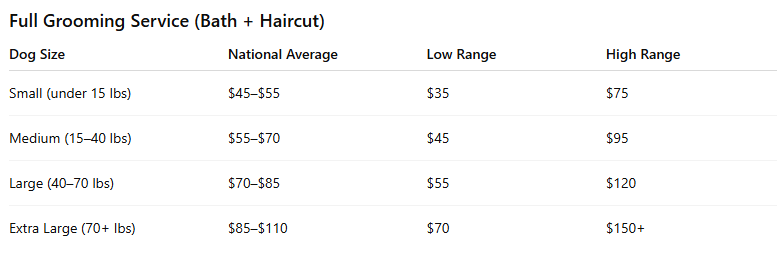
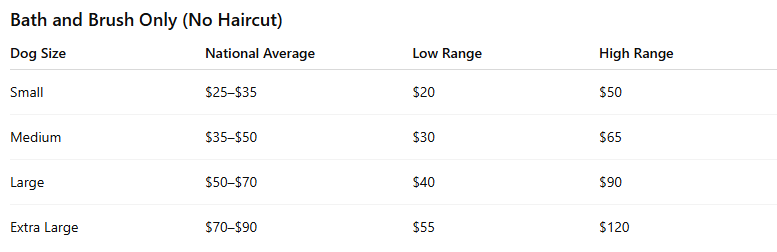
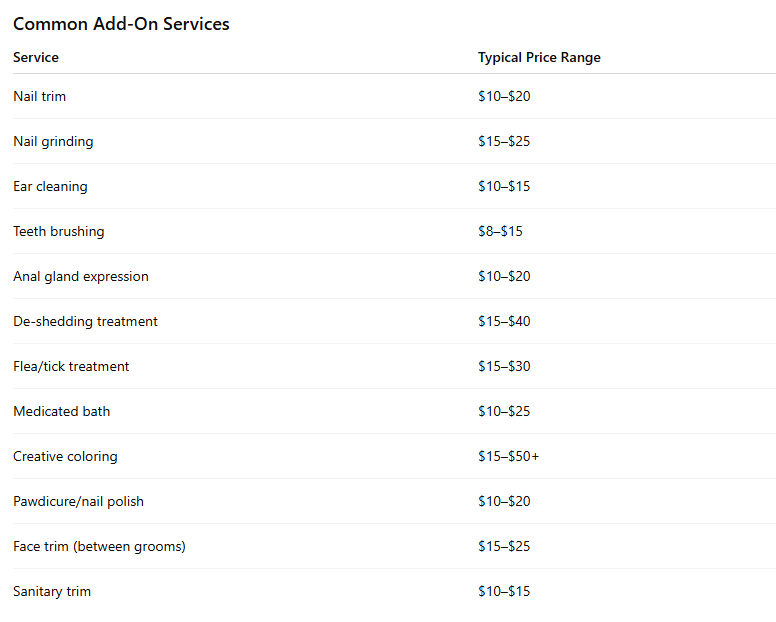
National averages provide a starting point, but local market research is essential.
Full Grooming Service (Bath + Haircut)
Bath and Brush Only (No Haircut)
Common Add-On Services
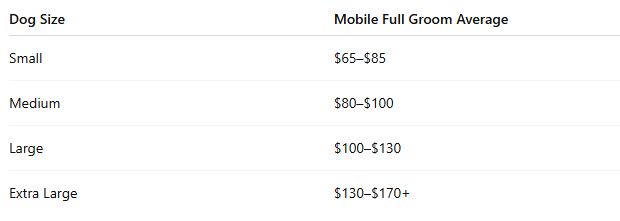
Mobile Grooming Premium
Mobile groomers typically charge 20–40% more than salon prices for the convenience factor.
Factors That Affect Pricing
Your prices shouldn’t be arbitrary. These factors determine what you can (and should) charge.
1. Your Location
Geography dramatically impacts pricing:
- Major metro areas (NYC, LA, SF): 30–50% above national average
- Suburban areas: Near or slightly above national average
- Rural areas: Often 10–20% below national average
- Affluent neighborhoods: Premium pricing expected and accepted
2. Your Experience and Credentials
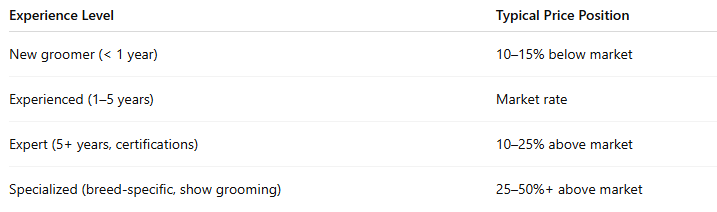
3. Coat Type and Condition
Different coats require different time investments.
Low-maintenance coats (smooth, short):
- Labradors, Beagles, Boxers
- Quick baths, minimal styling
- Price at or below average
Medium-maintenance coats:
- Golden Retrievers, German Shepherds, Huskies
- Significant de-shedding needed
- Price at average to slightly above
High-maintenance coats (curly, long, double):
- Poodles, Doodles, Shih Tzus, Bichons
- Require more time and skill
- Price above average
Matted dogs:
- Always charge more for matting
- Consider hourly rate for severe cases
- Clearly communicate pricing before starting
4. Dog Size vs. Actual Work
Size matters, but so does coat density and behavior.
A 60-lb Lab might take 45 minutes, while a 20-lb heavily coated Pomeranian might take 90 minutes. Adjust pricing based on time and effort—not just size.
5. Breed Complexity
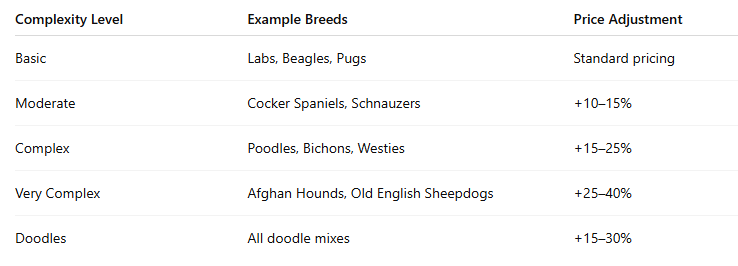
6. Dog Behavior
Difficult dogs warrant additional charges.
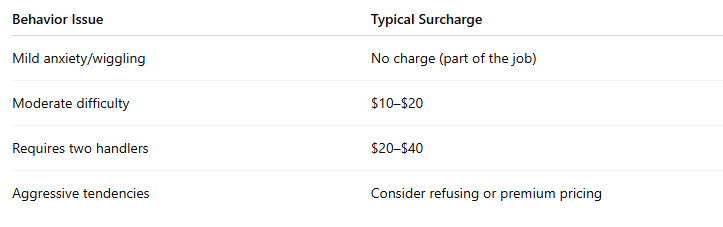
7. Additional Services Requested
Build in prices for extras before clients ask:
- Special shampoos (hypoallergenic, medicated)
- Extra brushing for shedding dogs
- Detailed styling or creative requests
- Same-day or emergency appointments
Pricing Models Explained
Model 1: Size-Based Pricing
The simplest approach—prices based purely on dog size.
Pros:
- Easy for clients to understand
- Simple to communicate and quote
Cons:
- Doesn’t account for coat type
- May undercharge for high-maintenance small dogs
- May overcharge for low-maintenance big dogs
Example:
- Small: $50
- Medium: $65
- Large: $80
- XL: $100
Model 2: Breed-Specific Pricing
Different prices for different breeds.
Pros:
- More accurately reflects work required
- Fair to both groomer and client
Cons:
- More complex to communicate
- Mixed breeds are tricky
- Requires memorizing many prices
Example:
- Labrador: $60
- Golden Retriever: $75
- Standard Poodle: $95
- Goldendoodle: $90
Model 3: A La Carte Pricing
Base bath price plus add-ons.
Pros:
- Clients only pay for what they want
- Flexibility for different needs
- Can increase ticket size with upsells
Cons:
- Can feel like nickel-and-diming
- Quotes take longer
- Final price can surprise clients
Example:
- Base bath: $30
- Haircut: +$30–$50
- Nail trim: +$15
- Ear cleaning: +$10
- Total: Custom quote
Model 4: Tiered Service Packages
Good / Better / Best package options.
Pros:
- Easy for clients to choose
- Natural upselling opportunity
- Clear value differentiation
Cons:
- Less flexibility
- May leave money on the table
- Clients may always choose cheapest
Example:
- Basic Bath: $45 (bath, dry, brush)
- Full Groom: $70 (bath, dry, haircut, nails, ears)
- Spa Day: $95 (full groom + teeth, massage, specialty shampoo)
Model 5: Flat Rate with Exceptions
One price covers everything, with listed exceptions.
Pros:
- Maximum simplicity
- No surprise costs
- Easy to communicate
Cons:
- May undercharge for complex dogs
- Requires clear exception policies
Example:
"$75 for any dog, any size. Additional charges for severe matting, de-shedding breeds, or special requests."
How to Research Your Local Market
Don’t guess at pricing—research it.
Secret Shopping Method
- Call 5–10 local groomers
- Ask for quotes on specific breeds and sizes
- Note what’s included in their pricing
- Ask about additional charges
- Record prices in a spreadsheet
Online Research
- Check competitors’ websites and social media
- Look at Google Business listings for pricing
- Read reviews mentioning prices
- Check Yelp, Nextdoor, and local Facebook groups
Position Yourself Strategically
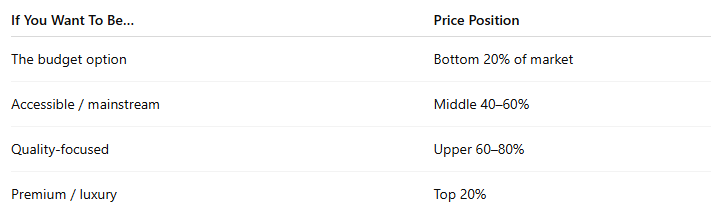
Most sustainable businesses position in the middle-to-upper range. Avoid racing to the bottom.
Calculating Your Required Pricing
Work backwards from what you need to earn.
Step 1: Determine Your Income Goal
Annual income goal: $________
Step 2: Calculate Working Days
- Days per week: ______
- Weeks per year: ______ (subtract vacation)
- Total working days: ______
Step 3: Estimate Dogs Per Day
Realistic capacity:
- Solo groomer: 4–8 dogs/day
- With assistant: 6–12 dogs/day
Dogs per day: ______
Step 4: Calculate Required Revenue Per Dog
Income goal ÷ Working days ÷ Dogs per day = Required average
Example:
- Goal: $60,000/year
- Working days: 250 (50 weeks × 5 days)
- Dogs per day: 6
- Required: $60,000 ÷ 250 ÷ 6 = $40 minimum average per dog
Step 5: Add Operating Costs
Don’t forget expenses:
- Supplies: $5–$10 per dog
- Rent/utilities portion
- Insurance, software, and other overhead
If expenses are $15 per dog and you need $40 profit, charge a minimum of $55 per dog.
Handling Pricing Challenges
“Your Prices Are Too High”
Response options:
- “I understand price is a factor. Let me share what’s included in my service…”
- “I do offer a bath-only option at $X if full grooming doesn’t fit your budget.”
- “My pricing reflects my experience and the quality products I use for every dog.”
Stand firm if you’re priced fairly for your market and quality level.
Dealing with Matted Dogs
Always charge more for matting. Options include:
- Per-severity surcharge: $15 / $30 / $50
- Hourly rate for severely matted dogs
- Flat demat fee
Always communicate before starting. No one likes surprise charges.
Raising Prices
Prices should increase over time.
When to raise:
- Annually (minimum)
- When costs increase
- When demand exceeds capacity
- After gaining significant experience or certifications
How much:
- 3–5% annually is standard
- 10%+ requires strong justification
How to communicate:
- Give 30–60 days notice
- Briefly explain the reason
- Thank clients for their loyalty
Sample script:
“Hi [Name]! Starting [date], my prices will increase by [amount]. This helps me continue providing the quality care [Pet Name] deserves. Thank you for your continued trust!”
Pricing for Profitability
Know Your Numbers
Track these metrics:
- Average ticket: Total revenue ÷ Dogs groomed
- Revenue per hour: Total revenue ÷ Hours worked
- Profit per dog: Revenue − Direct costs
Increase Average Ticket
- Offer premium add-ons
- Create spa packages
- Retail products
- Introduce memberships
Reduce Time Per Dog
More dogs at the same quality = more revenue.
- Improve efficiency
- Invest in time-saving equipment
- Train clients to bring dogs ready
- Book efficiently (similar breeds together)
Frequently Asked Questions
How often should I raise prices?
At minimum, annually. Many groomers raise prices every 6–12 months. Don’t wait until you resent your rates.
Should I publish my prices?
Pros: Attracts price-conscious shoppers, filters mismatches, easy for clients.
Cons: Less flexibility, competitors see pricing, complex breeds are harder to list.
Middle ground: List starting prices or ranges and note “final pricing based on consultation.”
What if I’m just starting out?
Start slightly below market to build your client base quickly. Plan to reach market rate within 6–12 months.
How do I handle price-shoppers?
Some clients will always choose cheapest. Let them go. Focus on clients who value quality and convenience.
Should I charge more for last-minute bookings?
Many groomers add 10–25% for same-day or emergency appointments. This is reasonable in most markets.
Your Pricing Action Plan
This Week
- Research 5–10 local competitors
- Calculate required revenue per dog
- Compare your numbers to market rates
This Month
- Finalize pricing structure
- Create a clear price menu
- Set matting and add-on charges
- Publish pricing clearly on website and booking
Ongoing
- Track average ticket and revenue per hour
- Review pricing every 6 months
- Adjust based on demand and costs
- Don’t be afraid to charge what you’re worth
Final Thoughts
Your prices tell a story about your business. They signal your quality, your confidence, and your value. Many groomers undercharge out of fear—fear of losing clients, fear of seeming greedy, fear of not being “worth it.”
Here’s the truth: clients who value their pets will pay for quality grooming. The right clients will pay your prices happily. The wrong clients will always want cheaper—and they’ll be your most demanding, least loyal customers.
Price for profit.
Price for sustainability.
Price for the business you want to build.
You’re worth it. Charge accordingly.



![Teddy vs Gingr: Complete Comparison [2026]](https://cdn.prod.website-files.com/64ac1f211014e9b293d35a4a/698dede605a81497c71168d0_Teddy%20vs%20Gingr_%20Complete%20Comparison%20%5B2026%5D.png)